skip to main |
skip to sidebar
By Cynthia Hubert
chubert@sacbee.com
Published: Thursday, Jun. 4, 2009 - 12:00 am | Page 1A
Could California become the first state in the nation to do away with welfare?
That doomsday scenario is on the table as lawmakers wrestle with a staggering $24.3 billion budget deficit.
County welfare directors are "in shock" at the very idea of getting rid of CalWORKs, which has been widely viewed as one of the most successful social programs in the state's history, said Bruce Wagstaff, director of the Department of Human Assistance in Sacramento.
"It's difficult to come up with the right adjective to react to this," Wagstaff said. "It would be devastating to the people we serve."
H.D. Palmer, a spokesman for the state Department of Finance, said California is in an unprecedented fiscal situation that has made all programs, from education to human services, vulnerable to deep and painful reductions.
"I don't wish for a moment to minimize the profound impact" that eliminating CalWORKs would have, Palmer said. "But the easy decisions are way past being in the rearview mirror for us. We face the specter of California not having cash on hand to pay its bills in July."
Wagstaff and other administrators are betting that the state will rescue the "welfare to work" program. But they are bracing for cuts that would slash benefits to the lowest levels since the late 1990s, when CalWORKs began as part of the federal government's bold reform of the welfare system.
"It would be a huge regression," said Nancy O'Hara, assistant director of the Yolo County Department of Employment and Social Services. "My mind reels just thinking about all of this."
California would save $157 million in the general fund by cutting CalWORKs altogether, according to the County Welfare Directors Association. But the group warns that the state would lose some $620 million in federal funds for the program. Palmer put the projected federal loss much higher, at $3.7 billion.
The association argues that eliminating CalWORKs would force thousands of families into homelessness, hurt the state economically and put added pressure on already strapped county assistance programs.
"No other state has eliminated all aid to dependent children, and no other First World country that we are aware of has no safety net for poor families," said Frank Mecca, the group's executive director. "There really is no fallback, especially given the financial condition that most counties are in."
O'Hara predicted higher rates of child abuse and abandonment if CalWORKs were to disappear.
"I can see it happening, like it did during the Great Depression when people could no longer provide for their children," O'Hara said. "I have not allowed myself to think about it in detail. I'm holding out hope that this won't happen."
CalWORKs, which replaced Aid to Families with Dependent Children in California, serves some 525,000 families each month, Mecca said. Welfare caseloads have dropped by half since its inception, he said, although recently they have begun to creep up again because of the wobbly economy.
"CalWORKs represents a real cultural change in the way welfare programs operate, and it's worked. It has proven to be a success," Wagstaff said. "People have gotten jobs. We have seen good outcomes for kids. Poverty rates have gone down. It's almost unthinkable to imagine taking this step backwards."
In Sacramento County, 33,500 families receive CalWORKs benefits, including more than 62,000 children, Wagstaff said. A family of three gets a monthly check of $689, plus food stamps. But CalWORKs does more than simply issue checks, he pointed out. It helps people, many of whom have depended on public assistance for years, learn new skills and get jobs, with subsidies for child care.
"Even as the unemployment rate was going up, we were still putting thousands of people to work," said Wagstaff. "I would argue that when the economy is down, the need for these kinds of services is higher than ever."
Roxanne Morales, 44, lived off welfare "for many years" and credits CalWORKs with turning her life around.
When she learned more than a decade ago that the rules for welfare were changing and she would have to get a job or go to school to retain her benefits, Morales panicked.
"I had my first child at 16," she said. "I had never had a job before. I had no clue. But they pushed me, and I am ever so glad they did."
Today Morales has risen from customer service representative to field supervisor at Maximus Inc., which helps state and local governments manage programs such as Medi-Cal. She is financially independent and happy, she said.
"I would not be in this position today if not for CalWORKs," said Morales. "There is no way they can eliminate this program."
Wagstaff, who helped craft CalWORKs, said he is confident it will survive. "We have no instructions from anyone about shutting it down," he said. "But something big likely is going to happen."
Mecca agreed.
"It's been gratifying to hear from people on both sides of the aisle that eliminating CalWORKs would be unacceptable," said Mecca. "But the magnitude of the state's fiscal problems and the politics in Sacramento are such that we have to take every proposal seriously."
An earlier state budget proposal called for a 6 percent cut in CalWORKs grants, on top of a 4 percent cut scheduled to take effect July 1. It would have eliminated aid to children whose parents are being cut off because they've reached their 60-month time limits for welfare assistance, among other things.
Those cuts might seem palatable next to a proposal to eliminate CalWORKs entirely, Mecca said.
"There is a prevailing view that folks are being softened up for very serious, but less egregious, cuts," he said. "But if that's the strategy, it's reckless and irresponsible."
Palmer said the proposal is no bluff.
"This is not a test," he said.
Call The Bee's Cynthia Hubert, (916) 321-1082.
By PETER BAKER and JEFF ZELENY
Published: May 26, 2009 (New York Times)
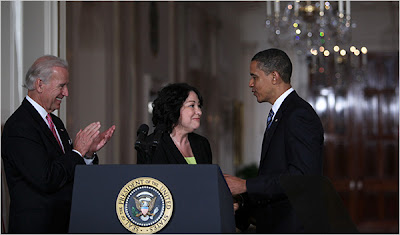
WASHINGTON — President Obama announced Tuesday that he would nominate Sonia Sotomayor, a federal appeals judge in New York, to the Supreme Court, choosing a daughter of Puerto Rican parents who was raised in a Bronx public housing project to become the nation’s first Hispanic justice.
In making his first pick for the court, Mr. Obama emphasized Judge Sotomayor’s “extraordinary journey” from modest beginnings to the Ivy League and now the pinnacle of the judicial system. Casting her as the embodiment of the American dream, he touched off a confirmation battle that he hopes to wage over biography more than ideology.
Judge Sotomayor’s past comments about how her sex and ethnicity shaped her decisions, and the role of appeals courts in making policy, generated instant conservative complaints that she is a judicial activist. Senate Republicans vowed to scrutinize her record. But with Democrats in reach of the 60 votes needed to break a filibuster, the White House appeared eager to dare Republicans to stand against a history-making nomination at a time when both parties are courting the growing Hispanic vote.
“When Sonia Sotomayor ascends those marble steps to assume her seat on the highest court of the land,” Mr. Obama said as he introduced her in the East Room of the White House, “America will have taken another important step towards realizing the ideal that is etched above its entrance: Equal justice under the law.”
Ms. Sotomayor, 54, a graduate of Princeton and Yale who served as a prosecutor, corporate litigator and federal district judge before joining the United States Court of Appeals for the Second Circuit, in New York, a decade ago, would become the nation’s 111th justice.
She would be the third woman to hold a seat on the court and the sixth person on the current nine-member panel with a Roman Catholic background.
If confirmed to succeed Justice David H. Souter, a mainstay of the liberal wing who is retiring, Judge Sotomayor would probably not change the court’s broad philosophical balance. But her views on same-sex marriage, gun rights, financial and environmental regulation, executive power and other polarizing issues could help shape judicial rulings for years, if not decades, to come.
At the heart of the fight over her nomination will be a debate over the role that a judge’s experience should play in rendering decisions. Although Mr. Obama said on Tuesday that “a judge’s job is to interpret, not make law,” his emphasis on a nominee with “empathy” has generated criticism from Republicans, who saw that as code for legislating personal views from the bench.
Judge Sotomayor has said that “our experiences as women and people of color affect our decisions.” In a lecture in 2001 on the role her background played in her jurisprudence, she said, “I would hope that a wise Latina woman with the richness of her experiences would more often than not reach a better conclusion than a white male who hasn’t lived that life.”
She also said at a conference in 2005 that a “court of appeals is where policy is made,” a statement she seemed to understand at the time would be controversial, because she added, “I know this is on tape and I should never say that, because we don’t make law.” The White House said she meant that appeals courts play a greater role in interpreting laws than district courts, but Republicans pointed to the comment as another sign that she would try to impose her values in rendering decisions.
“Judge Sotomayor is a liberal activist of the first order who thinks her own personal political agenda is more important than the law as written,” said Wendy E. Long, counsel to the Judicial Confirmation Network, a conservative group. “She thinks that judges should dictate policy and that one’s sex, race and ethnicity ought to affect the decisions one renders from the bench.”
Other conservatives said they would focus on her ruling in a New Haven affirmative action case or on how she might rule on same-sex marriage. “Abortion is in some sense a stale issue that has been fought over many times, but gay marriage is very much up for grabs,” said Curt Levey, executive director of the Committee for Justice, a legal group. “Gay marriage will be bigger than abortion.”
As she was nominated on Tuesday, Judge Sotomayor did not retreat from her view that judges ought to look at the impact of their rulings. “I strive never to forget the real-world consequences of my decisions on individuals, businesses and government,” she said.
While conservative groups took aim, Republican senators responded more cautiously, weighing how aggressively they want to fight her confirmation. Twenty-nine Senate Republicans voted against her confirmation to the appellate bench in 1998, including Mitch McConnell of Kentucky, now the party’s Senate leader, while 25 voted for her. Of those still in the Senate, 11 voted against her and 9 for her.
Mr. McConnell said on Tuesday that the Senate would not be a “rubber stamp” and promised that Republicans would “examine her record to ensure she understands that the role of a jurist in our democracy is to apply the law even-handedly, despite their own feelings or personal or political preferences.”
By KATIE HAFNER (New York Times)
Published: May 25, 2009
They do it late at night when their parents are asleep. They do it in restaurants and while crossing busy streets. They do it in the classroom with their hands behind their back. They do it so much their thumbs hurt.
Spurred by the unlimited texting plans offered by carriers like AT&T Mobility and Verizon Wireless, American teenagers sent and received an average of 2,272 text messages per month in the fourth quarter of 2008, according to the Nielsen Company — almost 80 messages a day, more than double the average of a year earlier.
The phenomenon is beginning to worry physicians and psychologists, who say it is leading to anxiety, distraction in school, falling grades, repetitive stress injury and sleep deprivation.
Dr. Martin Joffe, a pediatrician in Greenbrae, Calif., recently surveyed students at two local high schools and said he found that many were routinely sending hundreds of texts every day.
“That’s one every few minutes,” he said. “Then you hear that these kids are responding to texts late at night. That’s going to cause sleep issues in an age group that’s already plagued with sleep issues.”
The rise in texting is too recent to have produced any conclusive data on health effects. But Sherry Turkle, a psychologist who is director of the Initiative on Technology and Self at the Massachusetts Institute of Technology and who has studied texting among teenagers in the Boston area for three years, said it might be causing a shift in the way adolescents develop.
“Among the jobs of adolescence are to separate from your parents, and to find the peace and quiet to become the person you decide you want to be,” she said. “Texting hits directly at both those jobs.”
Psychologists expect to see teenagers break free from their parents as they grow into autonomous adults, Professor Turkle went on, “but if technology makes something like staying in touch very, very easy, that’s harder to do; now you have adolescents who are texting their mothers 15 times a day, asking things like, ‘Should I get the red shoes or the blue shoes?’ ”
As for peace and quiet, she said, “if something next to you is vibrating every couple of minutes, it makes it very difficult to be in that state of mind.
“If you’re being deluged by constant communication, the pressure to answer immediately is quite high,” she added. “So if you’re in the middle of a thought, forget it.”
Michael Hausauer, a psychotherapist in Oakland, Calif., said teenagers had a “terrific interest in knowing what’s going on in the lives of their peers, coupled with a terrific anxiety about being out of the loop.” For that reason, he said, the rapid rise in texting has potential for great benefit and great harm.
“Texting can be an enormous tool,” he said. “It offers companionship and the promise of connectedness. At the same time, texting can make a youngster feel frightened and overly exposed.”
Texting may also be taking a toll on teenagers’ thumbs. Annie Wagner, 15, a ninth-grade honor student in Bethesda, Md., used to text on her tiny LG phone as fast as she typed on a regular keyboard. A few months ago, she noticed a painful cramping in her thumbs. (Lately, she has been using the iPhone she got for her 15th birthday, and she says texting is slower and less painful.)
Peter W. Johnson, an associate professor of environmental and occupational health sciences at the University of Washington, said it was too early to tell whether this kind of stress is damaging. But he added,
“Based on our experiences with computer users, we know intensive repetitive use of the upper extremities can lead to musculoskeletal disorders, so we have some reason to be concerned that too much texting could lead to temporary or permanent damage to the thumbs.”
Annie said that although her school, like most, forbids cellphone use in class, with the LG phone she could text by putting it under her coat or desk.
Her classmate Ari Kapner said, “You pretend you’re getting something out of your backpack.”
Teachers are often oblivious. “It’s a huge issue, and it’s rampant,” said Deborah Yager, a high school chemistry teacher in Castro Valley, Calif. Ms. Yager recently gave an anonymous survey to 50 of her students; most said they texted during class.
“I can’t tell when it’s happening, and there’s nothing we can do about it,” she said. “And I’m not going to take the time every day to try to police it.”
Dr. Joffe says parents tend to be far less aware of texting than of, say, video game playing or general computer use, and the unlimited plans often mean that parents stop paying attention to billing details. “I talk to parents in the office now,” he said. “I’m quizzing them, and no one is thinking about this.”
Still, some parents are starting to take measures. Greg Hardesty, a reporter in Lake Forest, Calif., said that late last year his 13-year-old daughter, Reina, racked up 14,528 texts in one month. She would keep the phone on after going to bed, switching it to vibrate and waiting for it to light up and signal an incoming message.
Mr. Hardesty wrote a column about Reina’s texting in his newspaper, The Orange County Register, and in the flurry of attention that followed, her volume soared to about 24,000 messages. Finally, when her grades fell precipitously, her parents confiscated the phone.
Reina’s grades have since improved, and the phone is back in her hands, but her text messages are limited to 5,000 per month — and none between 9 p.m. and 6 a.m. on weekdays.
Yet she said there was an element of hypocrisy in all this: her mother, too, is hooked on the cellphone she carries in her purse.
“She should understand a little better, because she’s always on her iPhone,” Reina said. “But she’s all like, ‘Oh well, I don’t want you texting.’ ” (Her mother, Manako Ihaya, said she saw Reina’s point.) Professor Turkle can sympathize. “Teens feel they are being punished for behavior in which their parents indulge,” she said. And in what she calls a poignant twist, teenagers still need their parents’ undivided attention.
“Even though they text 3,500 messages a week, when they walk out of their ballet lesson, they’re upset to see their dad in the car on the BlackBerry,” she said. “The fantasy of every adolescent is that the parent is there, waiting, expectant, completely there for them.”
Last Updated: Tuesday, 19 September 2006, 16:46 GMT 17:46 UK
Thailand's latest political crisis traces its roots back to January when Prime Minister Thaksin Shinawatra sold his family's stake in the telecoms firm Shin Corp.
The move angered many, mainly urban Thais, who complained that the family avoided paying tax and had passed control of an important national asset to Singaporean investors.
It led to mass protests and calls for the resignation of the prime minister, who was already under pressure over his handling of a Muslim insurgency in the south and his extensive control over the media.
In a bid to tackle the crisis, and to show he still had widespread public support despite regular massive street protests in Bangkok, Mr Thaksin dissolved parliament in February and called a snap election for April.
Mr Thaksin's Thai Rak Thai party won 57% of the vote in the April election, but millions of Thais cast protest votes and the opposition refused to take part.
After weeks of limbo, Thailand's highly-revered King Bhumibol Adulyadej called the situation a "mess" and ordered the courts to sort it out.
'Military plot'
The election result was ruled invalid by the Constitutional Court and a new date was set for later this year.
Mr Thaksin took a seven-week break from politics following the election, but came back to work in May.
The atmosphere has remained tense ever since.
The Thai media has speculated about dissatisfaction towards Mr Thaksin within the military, which is traditionally very loyal to the king.
There has also been talk of a split within some parts of the army, following an annual reshuffle which saw some officers with links to Mr Thaksin moved.
The rumours took on a new urgency last month when police intercepted a car driven by a military officer and carrying a large bomb, near the prime minister's house.
Mr Thaksin accused several military officers of plotting to assassinate him.
His opponents accused him of fabricating a story to win him support in the forthcoming election.
He promised to make it work by cutting 'waste, fraud and abuse.' It was never that easy. The real solutions are obvious, though.
Michael Hiltzik
May 21, 2009
Marx Brothers fans will recall that the political philosophy of Rufus T. Firefly in "Duck Soup" boiled down to this:
"If you think this country's bad off now, just wait 'til I get through with it."
I've often considered that to be the secret slogan of Arnold Schwarzenegger's administration. (Just substitute "this state" for "this country.") After Tuesday's election, it's no longer a secret.
Schwarzenegger had the kind of voter support in 2003 that would have allowed him to tell the voters the harsh but necessary truths about California governance and force real reforms down their throats.
Instead, he uttered the same lies about state government and proposed the same nostrums as many of his predecessors: Californians are overtaxed and underserved, the budget can be balanced by cutting waste, fraud and abuse, etc. Like everyone else who has made these claims, he never delivered on his promise.
His cut in the car tax cost the state $3.6 billion per year, making him directly responsible for pretty much all of today's $21-billion budget deficit.
He hoped he could avoid reaping the whirlwind sown by these cliches. Unfortunately, Tuesday was Harvest Day.
Let's list a few of the lies he and our other political leaders have peddled about California's government and examine how they contributed to this week's debacle at the ballot box.
The most onerous lie is that Californians are burdened by the highest state taxes in the nation. The truth, according to 2006 figures derived from the U.S. Census, is that as a percentage of all personal income, California's tax and fee schedule ranks 18th in the country.
Then there's the canard that we unfairly soak our rich. This is supposedly a no-no, because the rich might flee, taking with them their sterling job-creating potential.
The dirty little secret, according to Citizens for Tax Justice, a left-leaning nonprofit group, is that California's wealthiest residents shoulder the lightest burden of any income group in the state. The top 1% of California income-earners (average 2007 income: $2.3 million) paid 7.4% of their income in various state taxes last year, counting the federal deduction for state taxes. The highest rate was paid by the poorest residents. Those earning $20,000 or less, with average income of $12,600, forked over 10.2% of their earnings in sales, excise, property and other levies.
This year's budget deal increased the disparity, raising the effective rate on the rich to 7.8%, but that on the poor to 11.1%.
The theme of the ballot campaign was that the state's chronic budget gridlock could be solved by more gridlock and more borrowing. All lies.
By no means does the governor deserve all the blame for the budget fiasco. Democrats and Republicans alike have abandoned any claim to statesmanship in Sacramento.
And what of the business community? Big corporations, entrepreneurs and mom-and-pop stores all have a huge stake in functional state government.
Yet the state Chamber of Commerce traditionally has offered one nostrum for California's budget ills: Cut taxes. But since it also claims to support better education and improved infrastructure, its approach has simply amounted to throwing the hard challenges back into the laps of a nonfunctional political establishment.
The truth is that real solutions to the budget crisis are obvious.
One: Eliminate, or at least loosen substantially, the two-thirds legislative requirement to pass a budget or raise taxes.
This rule has allowed a small Republican minority to hold up all budget progress unless its reactionary program is incorporated in the deal. If the supermajority were pared back even to 60%, the minority lawmakers would be unable to block a budget unless they could enlist at least a few moderates in their cause. The improvement in the tone of legislating would be immediate.
Two: Remove legislative term limits. This ridiculous provision has reduced the Capitol to a nursery full of would-be legislators needing afternoon naps. Worse, it has sapped legislative leadership of its vigor.
Since mid-1995, there have been nine speakers of the Assembly. Over the previous 20 years, there were two, including Willie Brown, the original target of the term-limit movement. You want to tell me that government in Sacramento has improved since then? As long as term limits exist, we'll never have a 21st-century state government.
Three is the Big One: Revise Proposition 13. Prop 13 is often described as a tax-cutting measure, but that scarcely does justice to the damage it has caused.
By rendering the property tax useless as a revenue device, Prop 13 hit local governments especially hard. Key budgeting authority devolved from cities and counties up to Sacramento, where they have to compete with the state government for money. You want your streets paved or more teachers for your third grade? Stand in line behind the health department, or the corrections department, or Caltrans.
So city streets deteriorate and local schools get worse. Police and firefighters are laid off. All the places where the voters come into face-to-face contact with their governments crumble.
The result? Voters get more cynical, more convinced that government is expensive and useless. It's a vicious circle -- the more government is unable to do the things voters want it to do, the less faith the voters have in government and the less they're willing to spend on it. Which leaves it with less money to do the things voters want. And on and on.
Reversing the worst effects of Proposition 13 doesn't take rocket science. Commercial property should be subject to regular reassessment -- the "split roll" that, inexplicably, can't gain traction in Sacramento. Cash-strapped homeowners can be provisionally protected from the burden of higher residential assessments -- say by allowing some assessments to be deferred until the home is sold.
Plainly, local government needs to recover its authority to collect revenue directly. That would help our political leadership make the case that, considering the quality of the services and institutions state and local government provide, Californians aren't overtaxed but undertaxed -- and the wealthy are the most undertaxed of all.
If Tuesday's election proves anything, it's that California's political sacred cows all need to be herded into the abattoir and dismembered, once and for all.
Breaking the cycle that has brought us to this pass will take political courage and real statesmanship. California's voters have been trained for too long to think they can have roads, schools, universities, clean air and other amenities without paying their true cost. The task of our next generation of leaders will be to show that California is not ungovernable -- it's just been ungoverned.
Michael Hiltzik's column appears Mondays and Thursdays. Reach him at michael.hiltzik@latimes.com, read his previous columns at www.latimes.com/hiltzik, and follow @latimeshiltzik on Twitter.
By Jonathan S. Landay and Warren P. Strobel, McClatchy Newspapers Jonathan S. Landay And Warren P. Strobel, Mcclatchy Newspapers – Thu May 21, 7:10 pm ET
WASHINGTON — Former Vice President Dick Cheney's defense Thursday of the Bush administration's policies for interrogating suspected terrorists contained omissions, exaggerations and misstatements.
In his address to the American Enterprise Institute , a conservative policy organization in Washington , Cheney said that the techniques the Bush administration approved, including waterboarding — simulated drowning that's considered a form of torture — forced nakedness and sleep deprivation, were "legal" and produced information that "prevented the violent death of thousands, if not hundreds of thousands, of innocent people."
He quoted the Director of National Intelligence, Adm. Dennis Blair , as saying that the information gave U.S. officials a "deeper understanding of the al Qaida organization that was attacking this country."
In a statement April 21 , however, Blair said the information "was valuable in some instances" but that "there is no way of knowing whether the same information could have been obtained through other means. The bottom line is that these techniques hurt our image around the world, the damage they have done to our interests far outweighed whatever benefit they gave us and they are not essential to our national security."
A top-secret 2004 CIA inspector general's investigation found no conclusive proof that information gained from aggressive interrogations helped thwart any "specific imminent attacks," according to one of four top-secret Bush-era memos that the Justice Department released last month.
FBI Director Mueller Robert Muller told Vanity Fair magazine in December that he didn't think that the techniques disrupted any attacks.
— Cheney said that President Barack Obama's decision to release the four top-secret Bush administration memos on the interrogation techniques was "flatly contrary" to U.S. national security, and would help al Qaida train terrorists in how to resist U.S. interrogations.
However, Blair, who oversees all 16 U.S. intelligence agencies, said in his statement that he recommended the release of the memos, "strongly supported" Obama's decision to prohibit using the controversial methods and that "we do not need these techniques to keep America safe."
— Cheney said that the Bush administration "moved decisively against the terrorists in their hideouts and their sanctuaries, and committed to using every asset to take down their networks."
The former vice president didn't point out that Osama bin Laden and his chief lieutenant, Ayman al Zawahri , remain at large nearly eight years after 9-11 and that the Bush administration began diverting U.S. forces, intelligence assets, time and money to planning an invasion of Iraq before it finished the war in Afghanistan against al Qaida and the Taliban .
There are now 49,000 U.S. troops in Afghanistan fighting to contain the bloodiest surge in Taliban violence since the 2001 U.S.-led intervention, and Islamic extremists also have launched their most concerted attack yet on neighboring, nuclear-armed Pakistan .
— Cheney denied that there was any connection between the Bush administration's interrogation policies and the abuse of detainee at Iraq's Abu Ghraib prison, which he blamed on "a few sadistic guards . . . in violation of American law, military regulations and simple decency."
However, a bipartisan Senate Armed Services Committee report in December traced the abuses at Abu Ghraib to the approval of the techniques by senior Bush administration officials, including former Defense Secretary Donald H. Rumsfeld .
"The abuse of detainees in U.S. custody cannot simply be attributed to the actions of 'a few bad apples' acting on their own," said the report issued by Sens. Carl Levin , D- Mich. , and John McCain , R- Ariz. "The fact is that senior officials in the United States government solicited information on how to use aggressive techniques, redefined the law to create the appearance of their legality and authorized their use against detainees."
— Cheney said that "only detainees of the highest intelligence value" were subjected to the harsh interrogation techniques, and he cited Khalid Sheikh Mohammad , the alleged mastermind of the 9-11 attacks.
He didn't mention Abu Zubaydah, the first senior al Qaida operative to be captured after 9-11. Former FBI special agent Ali Soufan told a Senate subcommittee last week that his interrogation of Zubaydah using traditional methods elicited crucial information, including Mohammed's alleged role in 9-11.
The decision to use the harsh interrogation methods "was one of the worst and most harmful decisions made in our efforts against al Qaida ," Soufan said. Former State Department official Philip Zelikow , who in 2005 was then-Secretary of State Condoleezza Rice's point man in an internal fight to overhaul the Bush administration's detention policies, joined Soufan in his criticism.
— Cheney said that "the key to any strategy is accurate intelligence," but the Bush administration ignored warnings from experts in the CIA , the Defense Intelligence Agency , the State Department , the Department of Energy and other agencies, and used false or exaggerated intelligence supplied by Iraqi exile groups and others to help make its case for the 2003 invasion.
Cheney made no mention of al Qaida operative Ali Mohamed al Fakheri , who's known as Ibn Sheikh al Libi , whom the Bush administration secretly turned over to Egypt for interrogation in January 2002 . While allegedly being tortured by Egyptian authorities, Libi provided false information about Iraq's links with al Qaida , which the Bush administration used despite doubts expressed by the DIA.
A state-run Libyan newspaper said Libi committed suicide recently in a Libyan jail.
— Cheney accused Obama of "the selective release" of documents on Bush administration detainee policies, charging that Obama withheld records that Cheney claimed prove that information gained from the harsh interrogation methods prevented terrorist attacks.
"I've formally asked that (the information) be declassified so the American people can see the intelligence we obtained," Cheney said. "Last week, that request was formally rejected."
However, the decision to withhold the documents was announced by the CIA , which said that it was obliged to do so by a 2003 executive order issued by former President George W. Bush prohibiting the release of materials that are the subject of lawsuits.
— Cheney said that only "ruthless enemies of this country" were detained by U.S. operatives overseas and taken to secret U.S. prisons.
A 2008 McClatchy investigation, however, found that the vast majority of Guantanamo detainees captured in 2001 and 2002 in Afghanistan and Pakistan were innocent citizens or low-level fighters of little intelligence value who were turned over to American officials for money or because of personal or political rivalries.
In addition, German Chancellor Angela Merkel said on Oct. 5, 2005 , that the Bush administration had admitted to her that it had mistakenly abducted a German citizen, Khaled Masri , from Macedonia in January 2004 .
Masri reportedly was flown to a secret prison in Afghanistan , where he allegedly was abused while being interrogated. He was released in May 2004 and dumped on a remote road in Albania .
In January 2007 , the German government issued arrest warrants for 13 alleged CIA operatives on charges of kidnapping Masri.
— Cheney slammed Obama's decision to close the Guantanamo Bay prison camp and criticized his effort to persuade other countries to accept some of the detainees.
The effort to shut down the facility, however, began during Bush's second term, promoted by Rice and Defense Secretary Robert Gates .
"One of the things that would help a lot is, in the discussions that we have with the states of which they (detainees) are nationals, if we could get some of those countries to take them back," Rice said in a Dec. 12, 2007 , interview with the British Broadcasting Corp. "So we need help in closing Guantanamo ."
— Cheney said that, in assessing the security environment after 9-11, the Bush team had to take into account "dictators like Saddam Hussein with known ties to Mideast terrorists."
Cheney didn't explicitly repeat the contention he made repeatedly in office: that Saddam cooperated with al Qaida , a linkage that U.S. intelligence officials and numerous official inquiries have rebutted repeatedly.
The late Iraqi dictator's association with terrorists vacillated and was mostly aimed at quashing opponents and critics at home and abroad.
The last State Department report on international terrorism to be released before 9-11 said that Saddam's regime "has not attempted an anti-Western terrorist attack since its failed plot to assassinate former President ( George H.W.) Bush in 1993 in Kuwait ."
A Pentagon study released last year, based on a review of 600,000 Iraqi documents captured after the U.S.-led invasion, concluded that while Saddam supported militant Palestinian groups — the late terrorist Abu Nidal found refuge in Baghdad , at least until Saddam had him killed — the Iraqi security services had no "direct operational link" with al Qaida .
By Reid Wilson
Posted: 05/20/09 03:10 PM [ET]
Sen. Arlen Specter (D-Pa.) took the opportunity Wednesday to defend House Speaker Nancy Pelosi (D-Calif.), who has come under fire in recent weeks over a controversy surrounding when she was told of the use of enhanced interrogation techniques being used by the CIA.
"The CIA has a very bad record when it comes to — I was about to say 'candid'; that's too mild — to honesty," Specter, a former chairman of the Senate Intelligence Committee, said in a lunch address to the American Law Institute. He cited misleading information about the agency's involvement in mining harbors in Nicaragua and the Iran-Contra affair.
"Director [Leon] Panetta says the agency does not make it a habit to misinform Congress. I believe that is true. It is not the policy of the Central Intelligence Agency to misinform Congress," Specter said. "But that doesn't mean that they're all giving out the information."
Because of leaks that have come from Congress, Specter said, he understands the agency's hesitancy to disclose all its information.
"The current controversy involving Speaker Pelosi and the CIA is very unfortunate, in my opinion, because it politicizes the issue and it takes away attention from ... how does the Congress get accurate information from the CIA?" Specter said. "For political gain, people are making headlines."
Specter and Pelosi have worked together on health and human services legislation, and the senator characterized the Speaker as "reliable and very able." He said he agrees with mounting calls that notes about the meetings should be publicly disclosed.
"Speaker Pelosi wants the notes disclosed. I think they ought to be, in the interest of transparency," Specter said. "The Speaker's entitled to have as much light shed on this as possible, and so [is] the public. The public is entitled to know what went on there."
The new Democrat also said Wednesday that he will ask the eventual nominee to replace retiring Supreme Court Justice David Souter what sort of cases he or she would allow to be heard.
"You can't ask the nominee how the nominee is going to decide a case. We all know that. But I think it's a fair question to say, 'What cases will you hear? What cases will you take?' " Specter said.
Four of the nine Supreme Court justices must agree to grant a writ of certiorari to hear a case. Specter said he was troubled by the current court's refusal to hear several cases dealing with executive authority, which he worried has been expanded too greatly since the Sept. 11, 2001, terrorist attacks.
Specter, who served as the Republican chairman of the Senate Judiciary Committee during confirmation hearings for Justices John Roberts and Samuel Alito, has been relegated to the most junior perch on the committee after switching to the Democratic Party.
But as a centrist Democrat, Specter will remain one of the key votes in the Senate as interest groups on both sides pressure him to support or oppose the eventual nominee. Specter has said he will remain an independent voice in the Senate, and in announcing his party switch affirmed that he still will oppose Dawn Johnsen's nomination to head the Office of Legal Counsel.
Only one other Democrat — Sen. Ben Nelson (Neb.) — has taken the same position opposing Johnsen.
Specter has been involved in every Supreme Court nomination fight since being elected to the Senate in 1980. His questioning of Robert Bork is credited with helping take down President Reagan's nominee in 1987, and he played a key role in questioning Anita Hill during Justice Clarence Thomas's confirmation hearings in 1991.
Specter said aggressive questioning at confirmation hearings, which did not become standard procedure until the 1950s, is warranted.
"I'd let the process take its course. I don't think we have strayed too far. But then I participated in the Bork hearings," Specter said. "There are many in the Senate who take the position that there's not a whole lot of deference given to the president."
Since Bork's nomination collapsed, court nominations have become flashpoints between conservatives and liberals, with groups instantly mobilizing when a vacancy comes about.
"When the hearings are politicized, the whole process is political," Specter said. He said nominees, who routinely meet with key senators before their confirmation hearings, campaign aggressively to win their seats on the court.