skip to main |
skip to sidebar
Sun Jun 14, 2009 4:07pm EDT
WASHINGTON, June 14 (Reuters) - CIA director Leon Panetta says it's almost as if former vice president Dick Cheney would like to see another attack on the United States to prove he is right in criticizing President Barack Obama for abandoning the "harsh interrogation" of terrorism suspects.
"I think he smells some blood in the water on the national security issue," Panetta said in an interview published in The New Yorker magazine's June 22 issue.
"It's almost, a little bit, gallows politics. When you read behind it, it's almost as if he's wishing that this country would be attacked again, in order to make his point."
Cheney, who was a key advocate in the Bush administration of controversial interrogation methods such as waterboarding, has become as a leading Republican critic of Obama's ban on harsh interrogations and his plan to shut the U.S. military prison at Guantanamo Bay, Cuba.
In a blistering May 21 speech, Cheney said Obama's reversal of Bush-era policies were "unwise in the extreme" that would make the American people less safe.
Panetta called Cheney's actions "dangerous politics."
He told The New Yorker he had favored the creation of an independent truth commission to look into the detainee polices of former President George W. Bush. But the idea died in April when Obama decided such a panel could be seen as politically vindictive. (Reporting by David Morgan; Editing by Alan Elsner)
© Thomson Reuters 2009 All rights reserved
By Kim Murphy
June 13, 2009

Ted S. Warren / Associated Press
Erik Espinoza, right, and Anders Miller, center, both of Pike Place Fish Market, look on as J.J. Swanton, left, throws a fish in the salmon-tossing contest held in honor of the 100th anniversary of the Pike Place Market in Seattle in this Aug. 2007 file photo.
Animal rights group PETA protests their plans to exhibit their fish-flinging technique at an upcoming veterinarians conference.
Reporting from Seattle -- In this noisy den of brine and ice, scales and slime, fish always have been part meat, part missile.
One man points to an enormous white-bellied fish, and another man in a wet apron scoops it up from the ice, hoists it over his shoulder and sends it flying 15 feet toward the counter
"Hali-BUT! Hali-BUT! Heyyyyyy!" six men scream in unison. "Goin' right home! Goin' right home!" The counterman catches the hurtling fish neatly between the head and tail fin and slaps it onto a wrapping sheet.
The Pike Place Fish Market is the legendary home of the flying fish: Halibut as big as a wrestler's thigh, spiky medallions of crab, the smooth, rainbow flesh of Chinook salmon, all become rapid-fire marine rockets in the hands of Seattle's fishmongers -- who are as famous for the speed of their fish as for its freshness.
But did anyone ever think of the fish?
Asserting that the practice of lobbing fish above the heads of patrons and tourists at the market and other venues is disrespectful to creatures that already have gone through a lot, an animal rights group is protesting plans to stage a flying-fish exhibition at an upcoming national veterinarians conference in Seattle.
Ultimately, they would like to see the practice banned at the fish market too. They argue that tourists would not be nearly so eager to snap photos if dead kittens or gutted lambs were sailing over their heads.
"Killing animals so you can toss their bodies around for amusement is just twisted," said Ashley Byrne, senior campaigner for People for the Ethical Treatment of Animals in Washington, D.C.
"And it particularly sends a terrible message to the public when vets call it fun to toss around the corpses of animals. If anyone should be promoting compassion and not callousness toward animals, it should be vets."
The 102-year-old Pike Place Market is perhaps Seattle's most important institution, a cacophony of commerce in the middle of the city that hosts 10 million visitors a year, including flocks of tourists and Seattleites in search of lunch and fresh flowers.
Stretching three levels down the hillside above Elliott Bay, the narrow, crowded rows of stalls and shops begin in the open-air bustle along Pike Street and Western Avenue, opposite the original Starbucks. The air is fragrant with the smells of fish, hot fried mini-doughnuts, Hmong flower sellers' fresh blooms and sizzling gourmet sausage.
In the seemingly endless warrens of shops in the basement and nearby alleys, visitors might find anarchist treatises, herbal tinctures, vintage comic books and last Friday's newspaper from Sarajevo.
The market's flying fish have become such an institution of the Pacific Northwest that the fishmongers often are hired to give demonstrations at conferences, hospitals, schools and company retreats.
Jeremy Ridgway, one of the managers at the market, said that he has done fish shows for the ministry of manpower in Singapore, for schoolchildren in Oklahoma and at countless other venues.
"People get excited about it. They get to hold a fish; they get to touch it. A lot of people have never held a salmon before. In Oklahoma, they don't have wild fish, unless you count catfish," he said.
He said fishmongers are bewildered at the notion that their toss -- which they describe as merely the quickest way of getting fish from display cases to the counter -- shows any lack of reverence for a creature that is, after all, their livelihood.
"I mean, the fish are dead," Ridgway said. "The thing is, we're not laughing and making fun of them. . . . It's just Point A to Point B. That's why we do it."
"Two crabs!" somebody yells, and the smart ones in the crowd quickly duck.
In a letter to the veterinarian association, PETA Director Sarah King said the flying fish demonstration represents callous disregard for the suffering the creatures undergo before they come to the table.
"There is more than enough scientific evidence to prove that fish feel pain and that they do not die well at the hands of the fishing industry," she said, citing numerous studies that show fish have intelligence as well as sophisticated social structures.
"When the fish used in these 'tosses' are pulled up from the depths of the ocean, they undergo the excruciating pain of decompression. The intense pressure often ruptures their swim bladders and damages other internal organs. Then the fish slowly suffocate or are bludgeoned to death. Others are still alive when they are cut open. The fish toss celebrates cruelty to marine animals," King wrote.
W. Ron DeHaven, chief executive of the American Veterinary Medical Assn., said that the flying fish demonstration was scheduled during the convention's July 11 opening session as a team-building exercise for as many as 10,000 veterinarians, receptionists and veterinary technicians.
"We start from a fundamental standpoint as an association, where we support the use of animals for human purposes, such as food and fiber, exhibition and for use as pets and companions, and we think this is consistent with our principles," he said.
At the same time, he said, "we wouldn't want to do anything that would appear to be disrespectful of animals."
PETA has butted heads with the association in the past, criticizing it for not opposing the force-feeding of geese for foie gras or the tight confinement of mother pigs.
So simply switching to rubber fish for the convention demonstration -- after PETA offered to buy such substitutes -- may not be a good option either, DeHaven said.
"The vast majority of our members would support the use of fish for this purpose, and if we are perceived as caving to political pressure from PETA, there is vulnerability for us there, and I don't want to ignore that," he said.
Ridgway said the fishmongers were willing to throw the rubber variety for the vets, but wonders what the point would be. "It would be like throwing basketballs," he said.
"It's probably no more disrespectful than eating them," said Sue Carter, visiting the market one recent afternoon from Mukilteo, Wash., smiling as her salmon sailed toward the cash register. "I wouldn't want to see a fish gasping for air coming flying through the air. But one that's already on the way to the table, why not?"
Sympathy was on ice. Few were inclined to think it through, and those who did came up hungry.
"As far as whether I'd want to see dead cats being thrown around, well, who's going to throw dead cats, unless you're in China or something?" said Vancouver, Canada, resident Robin Graham. "A dead fish is a dead fish."
kim.murphy@latimes.com
By DAVID LEONHARDT
Published: June 9, 2009
There are two basic truths about the enormous deficits that the federal government will run in the coming years.
How Trillion-Dollar Deficits Were Created
The first is that President Obama’s agenda, ambitious as it may be, is responsible for only a sliver of the deficits, despite what many of his Republican critics are saying. The second is that Mr. Obama does not have a realistic plan for eliminating the deficit, despite what his advisers have suggested.
The New York Times analyzed Congressional Budget Office reports going back almost a decade, with the aim of understanding how the federal government came to be far deeper in debt than it has been since the years just after World War II. This debt will constrain the country’s choices for years and could end up doing serious economic damage if foreign lenders become unwilling to finance it.
Mr. Obama — responding to recent signs of skittishness among those lenders — met with 40 members of Congress at the White House on Tuesday and called for the re-enactment of pay-as-you-go rules, requiring Congress to pay for any new programs it passes.
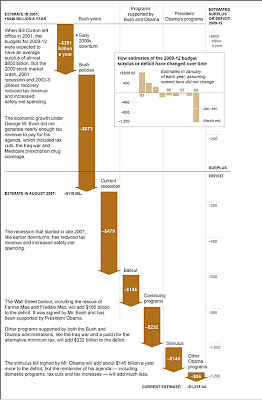
The story of today’s deficits starts in January 2001, as President Bill Clinton was leaving office. The Congressional Budget Office estimated then that the government would run an average annual surplus of more than $800 billion a year from 2009 to 2012. Today, the government is expected to run a $1.2 trillion annual deficit in those years.
You can think of that roughly $2 trillion swing as coming from four broad categories: the business cycle, President George W. Bush’s policies, policies from the Bush years that are scheduled to expire but that Mr. Obama has chosen to extend, and new policies proposed by Mr. Obama.
The first category — the business cycle — accounts for 37 percent of the $2 trillion swing. It’s a reflection of the fact that both the 2001 recession and the current one reduced tax revenue, required more spending on safety-net programs and changed economists’ assumptions about how much in taxes the government would collect in future years.
About 33 percent of the swing stems from new legislation signed by Mr. Bush. That legislation, like his tax cuts and the Medicare prescription drug benefit, not only continue to cost the government but have also increased interest payments on the national debt.
Mr. Obama’s main contribution to the deficit is his extension of several Bush policies, like the Iraq war and tax cuts for households making less than $250,000. Such policies — together with the Wall Street bailout, which was signed by Mr. Bush and supported by Mr. Obama — account for 20 percent of the swing.
About 7 percent comes from the stimulus bill that Mr. Obama signed in February. And only 3 percent comes from Mr. Obama’s agenda on health care, education, energy and other areas.
If the analysis is extended further into the future, well beyond 2012, the Obama agenda accounts for only a slightly higher share of the projected deficits.
How can that be? Some of his proposals, like a plan to put a price on carbon emissions, don’t cost the government any money. Others would be partly offset by proposed tax increases on the affluent and spending cuts. Congressional and White House aides agree that no large new programs, like an expansion of health insurance, are likely to pass unless they are paid for.
Alan Auerbach, an economist at the University of California, Berkeley, and an author of a widely cited study on the dangers of the current deficits, describes the situation like so: “Bush behaved incredibly irresponsibly for eight years. On the one hand, it might seem unfair for people to blame Obama for not fixing it. On the other hand, he’s not fixing it.”
“And,” he added, “not fixing it is, in a sense, making it worse.”
When challenged about the deficit, Mr. Obama and his advisers generally start talking about health care. “There is no way you can put the nation on a sound fiscal course without wringing inefficiencies out of health care,” Peter Orszag, the White House budget director, told me.
Outside economists agree. The Medicare budget really is the linchpin of deficit reduction. But there are two problems with leaving the discussion there.
First, even if a health overhaul does pass, it may not include the tough measures needed to bring down spending. Ultimately, the only way to do so is to take money from doctors, drug makers and insurers, and it isn’t clear whether Mr. Obama and Congress have the stomach for that fight. So far, they have focused on ideas like preventive care that would do little to cut costs.
Second, even serious health care reform won’t be enough. Obama advisers acknowledge as much. They say that changes to the system would probably have a big effect on health spending starting in five or 10 years. The national debt, however, will grow dangerously large much sooner.
Mr. Orszag says the president is committed to a deficit equal to no more than 3 percent of gross domestic product within five to 10 years. The Congressional Budget Office projects a deficit of at least 4 percent for most of the next decade. Even that may turn out to be optimistic, since the government usually ends up spending more than it says it will. So Mr. Obama isn’t on course to meet his target.
But Congressional Republicans aren’t, either. Judd Gregg recently held up a chart on the Senate floor showing that Mr. Obama would increase the deficit — but failed to mention that much of the increase stemmed from extending Bush policies. In fact, unlike Mr. Obama, Republicans favor extending all the Bush tax cuts, which will send the deficit higher.
Republican leaders in the House, meanwhile, announced a plan last week to cut spending by $75 billion a year. But they made specific suggestions adding up to meager $5 billion. The remaining $70 billion was left vague. “The G.O.P. is not serious about cutting down spending,” the conservative Cato Institute concluded.
What, then, will happen?
“Things will get worse gradually,” Mr. Auerbach predicts, “unless they get worse quickly.” Either a solution will be put off, or foreign lenders, spooked by the rising debt, will send interest rates higher and create a crisis.
The solution, though, is no mystery. It will involve some combination of tax increases and spending cuts. And it won’t be limited to pay-as-you-go rules, tax increases on somebody else, or a crackdown on waste, fraud and abuse. Your taxes will probably go up, and some government programs you favor will become less generous.
That is the legacy of our trillion-dollar deficits. Erasing them will be one of the great political issues of the coming decade.
E-mail: Leonhardt@nytimes.com
To understand the looming deficits, The New York Times analyzed Congressional Budget Office projections of the budget surplus or deficit for the years 2009-12, President Obama’s current term. The budget office has been making estimates for these years for nearly a decade now. The numbers that appear below are the average annual deficit or surplus for this four-year period.
Kelly Zito, Chronicle Staff Writer
Friday, June 5, 2009
(06-04) 18:10 PDT San Francisco --
Federal regulators prescribed sweeping changes Thursday to the dams, reservoirs and pumps that supply water to two-thirds of California in an effort to restore a salmon population whose steep decline has sounded an environmental alarm and led to the cancellation of two consecutive commercial fishing seasons.
While the measures could save the chinook salmon and other species from extinction, critics argue the plans reduce the water supply to people and farms at a time when the water system is strained by earlier environmental rules, drought, population growth and crumbling infrastructure.
On Thursday, an 800-page biological opinion released by the National Marine Fisheries Service found that operations of the state and federal water systems had jeopardized the state's spring-run chinook salmon, Central Valley steelhead, green sturgeon and Southern Resident killer whales. Moving water from one area of the delta to another and exporting increased supplies to cities and farms slashed flows for fish and boosted water temperatures, the report found.
The agency recommended increasing the amount of cold water stored at Shasta Dam, routing fish around a Red Bluff dam, closing "cross-channel" gates within the Sacramento-San Joaquin River Delta for longer periods, and cutting delta water exports by 5 to 7 percent. The U.S. Bureau of Reclamation, which represents both the state and federal water systems, expressed initial support of the opinion but said it would examine the document in detail before moving forward.
The aim is to make waterways more hospitable and accessible to spawning salmon, while also preventing the fish from getting trapped in the giant delta pumps that funnel water to 25 million Californians and hundreds of thousands of acres of farmland. Federal architects of the plan say California's future relies on reviving these fragile species.
The salmon population has declined by about 90 percent over the past six years, according to several West Coast fishing industry groups.
"What is at stake here is not just the survival of species, but the health of entire ecosystems and the economies that depend on them," said Maria Rea, National Oceanic and Atmospheric Administration Fisheries Service supervisor for the Sacramento office.
Governor critical of opinion
State officials, however, issued a stinging rebuke of the opinion.
"This federal biological opinion puts fish above the needs of millions of Californians and the health and security of the world's eighth-largest economy," Gov. Arnold Schwarzenegger said in a statement. "The piling on of one federal court decision after another in a species-by-species approach is killing our economy and undermining the integrity of the Endangered Species Act."
The governor said he would seek meetings with federal administrators to discuss the opinion.
Thursday's plan is the second released by the agency. Last year, U.S. District Judge Oliver Wanger in Fresno tossed the service's 2004 opinion, which critics contended favored politics over science.
Commercial salmon fisherman, idled for the second season in a row, said the latest plan may resurrect an industry they say historically poured more than $2 billion a year into the state economy.
During a normal year, dozens of fishing boats would be lined up along San Francisco's commercial piers unloading salmon payloads as high as $20,000, said Larry Collins, vice president of the Pacific Coast Federation of Fishermen's Associations. During a news conference Thursday held by Collins and other industry advocates, the piers were empty.
"We need to do what's right for these fishing communities, what's right for these fish, and we need to do it now," Collins said.
California water managers and representatives of agriculture greeted the plan with much more disappointment than hope. Most of the criticism rested on the plan's call for reducing water deliveries by 5 to 7 percent. The Department of Water Resources estimates deliveries have already been cut by as much as 20 percent after an earlier biological opinion on the threatened delta smelt. Around the state, drought and water cuts have forced many farmers to fallow prime farmland.
Rural, urban hardships
"It's another water supply cut on top of numerous ones over the years that are driving Central Valley economies into the tank," said Mike Wade, executive director of the California Farm Water Coalition. "This is just more of the same."
The cuts also impact urban areas around the state, served mainly by the state water project.
"The new opinion ... further chips away at our ability to provide a reliable water supply for California," said Department of Water Resources Director Lester Snow.
Several Bay Area agencies, including Santa Clara Valley Water District, Zone 7 Water Agency in Alameda County, Contra Costa Water District and Alameda County Water District, rely heavily on delta water.
Instead, Snow and others said the state must take a more comprehensive approach to solve the water network's myriad problems.
The Bay Delta Conservation Plan, a state environmental and planning process whose goals balance both delta ecosystem restoration and water supply reliability, may hold some of the answers. But environmentalists say fixing the water system is as much behavioral as it is structural.
"We have high hopes that the BDCP will help move us away from short-term fixes," said Ann Hayden, senior water resource analyst at Environmental Defense Fund. "But we also need to seriously address alternatives to water supply coming out of the bay-delta - recycling, conservation and groundwater management."
E-mail Kelly Zito at kzito@sfchronicle.com.
This article appeared on page A - 1 of the San Francisco Chronicle
JPost.com » Israel » Article
Jun 3, 2009 19:13 | Updated Jun 4, 2009 16:24
By ABE SELIG
Article's topics: Barack Obama
Chanting "No, you can't!" and waving signs bearing messages in a similar vein, nearly 200 people held a demonstration outside the US Consulate on the capital's Rehov Agron on Wednesday evening, protesting the growing American pressure to stop construction in West Bank settlements.
Speakers at the event included MK Michael Ben-Ari (National Union) and Esther Pollard, the wife of convicted spy Jonathan Pollard. All brought a similar message - that the American government does not have the right to dictate where Jews may or may not live within the Land of Israel.
"Mr. Obama, we started demonstrating 16 years ago," said Rabbi Shalom Gold, the founder of Kehillat Zichron Ya'acov in Jerusalem's Har Nof neighborhood, alluding to the early days of the Oslo Accords. "You were in your '30s and you probably didn't know the first thing about Eretz Yisrael... but we're part of God's divine plan, we're here and we're staying here!"
"Be a friend of Israel, but even if you won't be, we have the greatest ally in the world," he said, pointing to the heavens.
Esther Pollard followed, telling the crowd that her message to the US president was that "your problem isn't with Prime Minister Netanyahu, nor is it with the People of Israel. Your problem, Mr. President, is with the almighty God of Israel!"
The protest continued for more than two hours, as the demonstrators ebbed and flowed and consular staff across the street came out to watch the goings-on.
Poster showing Obama and...
The protest was only a part of a wider campaign launched by activists on Wednesday, in which they will try to counter the American stance by portraying Obama as an anti-Semite whose policies would harm the Jewish state.
Over the coming days, activists plan to hang posters throughout the country of Obama wearing a keffiyeh, flanked by the words, "Anti-Semite," and "Jew-hater," written in red in both English and Hebrew. Another poster published by the campaign shows Obama shaking hands with Iranian President Mahmoud Ahmadinejad against a background of a mushroom cloud from a nuclear explosion.
The Jewish National Front, which is backing the protests, said in a statement: "We decided to launch a campaign against the president of the United States and to say that Barack Hussein Obama is bad for the Jews."
"From the moment that he entered the White House, we have been feeling anti-Semitism and hatred toward Israel," the statement continued. "We have a number of plans, among which are demonstrations in the US and protests in front of the consulate and homes of the ambassadors."
Later Wednesday evening, Peace Now issued a statement harshly criticizing the campaign, saying the anti-Obama posters and demonstrations would cause considerable damage to the friendship between the US and Israel.
"The radical Right is damaging our strategic alliance with the US, and is embarrassing Israel in front of the world," the organization said. "[Prime Minister Binyamin Netanyahu] must renounce this campaign of the settlers at once, and act decisively against the hilltop youth and those who are breaking the law in the settlements."
Jerusalem Post staff contributed to this report.
By Cynthia Hubert
chubert@sacbee.com
Published: Thursday, Jun. 4, 2009 - 12:00 am | Page 1A
Could California become the first state in the nation to do away with welfare?
That doomsday scenario is on the table as lawmakers wrestle with a staggering $24.3 billion budget deficit.
County welfare directors are "in shock" at the very idea of getting rid of CalWORKs, which has been widely viewed as one of the most successful social programs in the state's history, said Bruce Wagstaff, director of the Department of Human Assistance in Sacramento.
"It's difficult to come up with the right adjective to react to this," Wagstaff said. "It would be devastating to the people we serve."
H.D. Palmer, a spokesman for the state Department of Finance, said California is in an unprecedented fiscal situation that has made all programs, from education to human services, vulnerable to deep and painful reductions.
"I don't wish for a moment to minimize the profound impact" that eliminating CalWORKs would have, Palmer said. "But the easy decisions are way past being in the rearview mirror for us. We face the specter of California not having cash on hand to pay its bills in July."
Wagstaff and other administrators are betting that the state will rescue the "welfare to work" program. But they are bracing for cuts that would slash benefits to the lowest levels since the late 1990s, when CalWORKs began as part of the federal government's bold reform of the welfare system.
"It would be a huge regression," said Nancy O'Hara, assistant director of the Yolo County Department of Employment and Social Services. "My mind reels just thinking about all of this."
California would save $157 million in the general fund by cutting CalWORKs altogether, according to the County Welfare Directors Association. But the group warns that the state would lose some $620 million in federal funds for the program. Palmer put the projected federal loss much higher, at $3.7 billion.
The association argues that eliminating CalWORKs would force thousands of families into homelessness, hurt the state economically and put added pressure on already strapped county assistance programs.
"No other state has eliminated all aid to dependent children, and no other First World country that we are aware of has no safety net for poor families," said Frank Mecca, the group's executive director. "There really is no fallback, especially given the financial condition that most counties are in."
O'Hara predicted higher rates of child abuse and abandonment if CalWORKs were to disappear.
"I can see it happening, like it did during the Great Depression when people could no longer provide for their children," O'Hara said. "I have not allowed myself to think about it in detail. I'm holding out hope that this won't happen."
CalWORKs, which replaced Aid to Families with Dependent Children in California, serves some 525,000 families each month, Mecca said. Welfare caseloads have dropped by half since its inception, he said, although recently they have begun to creep up again because of the wobbly economy.
"CalWORKs represents a real cultural change in the way welfare programs operate, and it's worked. It has proven to be a success," Wagstaff said. "People have gotten jobs. We have seen good outcomes for kids. Poverty rates have gone down. It's almost unthinkable to imagine taking this step backwards."
In Sacramento County, 33,500 families receive CalWORKs benefits, including more than 62,000 children, Wagstaff said. A family of three gets a monthly check of $689, plus food stamps. But CalWORKs does more than simply issue checks, he pointed out. It helps people, many of whom have depended on public assistance for years, learn new skills and get jobs, with subsidies for child care.
"Even as the unemployment rate was going up, we were still putting thousands of people to work," said Wagstaff. "I would argue that when the economy is down, the need for these kinds of services is higher than ever."
Roxanne Morales, 44, lived off welfare "for many years" and credits CalWORKs with turning her life around.
When she learned more than a decade ago that the rules for welfare were changing and she would have to get a job or go to school to retain her benefits, Morales panicked.
"I had my first child at 16," she said. "I had never had a job before. I had no clue. But they pushed me, and I am ever so glad they did."
Today Morales has risen from customer service representative to field supervisor at Maximus Inc., which helps state and local governments manage programs such as Medi-Cal. She is financially independent and happy, she said.
"I would not be in this position today if not for CalWORKs," said Morales. "There is no way they can eliminate this program."
Wagstaff, who helped craft CalWORKs, said he is confident it will survive. "We have no instructions from anyone about shutting it down," he said. "But something big likely is going to happen."
Mecca agreed.
"It's been gratifying to hear from people on both sides of the aisle that eliminating CalWORKs would be unacceptable," said Mecca. "But the magnitude of the state's fiscal problems and the politics in Sacramento are such that we have to take every proposal seriously."
An earlier state budget proposal called for a 6 percent cut in CalWORKs grants, on top of a 4 percent cut scheduled to take effect July 1. It would have eliminated aid to children whose parents are being cut off because they've reached their 60-month time limits for welfare assistance, among other things.
Those cuts might seem palatable next to a proposal to eliminate CalWORKs entirely, Mecca said.
"There is a prevailing view that folks are being softened up for very serious, but less egregious, cuts," he said. "But if that's the strategy, it's reckless and irresponsible."
Palmer said the proposal is no bluff.
"This is not a test," he said.
Call The Bee's Cynthia Hubert, (916) 321-1082.